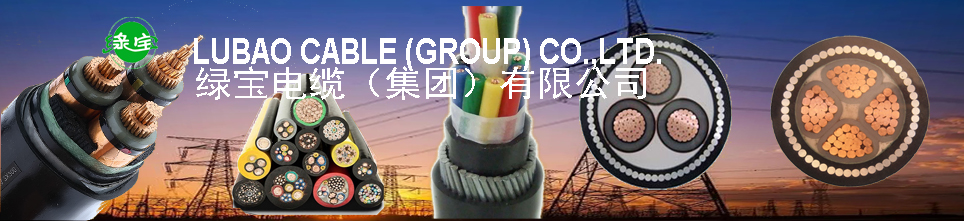
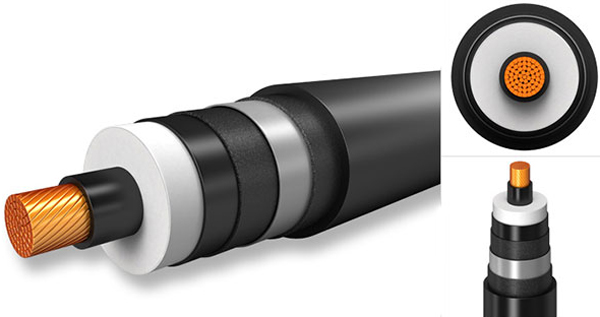
Power cables with copper or aluminium conductors,extruded XLPE insulation,longitudinal and radial sealing or lead sheathed with PE (PVC) outer sheath for rated voltage above 36kV up to 420 kV. For supply of electrical energy, laying in ground,ducts, pipes and air, in trefoil or flat formation.
MAXIMUM PERMISSIBLE CONDUCTOR TEMPERATURE
Normal Operation: 90℃.
Emergency Operation: 130℃.
Short Circuit Condition: 250℃
Current rating depends upon:
Installation conditions (ground, air, ducts, depth of burial, etc.)
Environmental effects – soil temp, soil thermal resistivity, depth of burial, spacing
Mutual heating – derates cable
Laying Method – Flat Formation, Close Touching Trefoil formation
Type of Bonding – Both End Bonding, Single Point Bonding & Cross bonding
The Current ratings and physical dimensions for the following constructions are given here;
1 Corrugated Aluminum sheath
a. 38/66 kV, b. 64/110 kV, c. 76/132 kV, d. 127/220 kV
2 Lead alloy E sheath
a. 38/66 kV, b. 64/110 kV, c. 76/132 kV, d. 127/220 kV
3 Copper wire screen – Polyal Sheath
a. 38/66 kV, b. 64/110 kV, c. 76/132 kV, d. 127/220 kV
Construction
Conductor
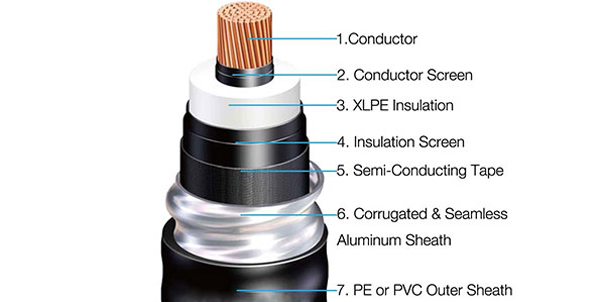
The conductor shall be formed from plain copper or aluminum, Basically of 2 types, compacted circular and segmental compacted circular.
Conductor above 1000 mm2 cross section shall be segmental (Milliken) conductors.
Conductor Screening:
Conductor screening of an extruded semiconducting XLPE compound shall be applied over the conductor. One or two layers of semiconducting tape(s) may be applied with suitable overlap between the conductor and the extruded semiconducting layer.
Insulation
The insulation shall be of dry – cured super clean XLPE compound with suitable thickness to meet dimensional, electrical and physical requirements. The insulation shall be suitable for operation in wet or dry locations at conductor temperature not exceeding 90C for normal condition, 130C for emergency overload conditions and 250C for short circuit conditions.
Insulation Screening:
The insulation screening shall be applied directly over the insulation and shall consist of a layer of extruded semiconducting compound. The extruded semiconducting compound shall be a thermoset type and firmly and totally bonded to the insulation.
Metal Wire Screen:
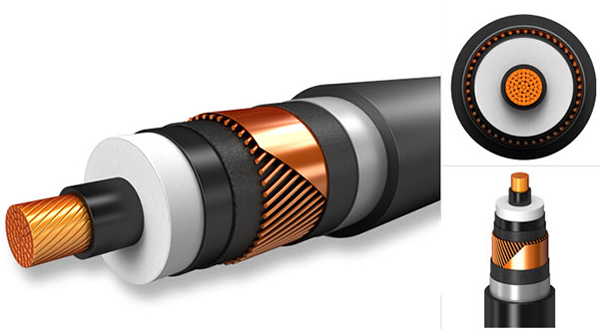
When a layer of copper wire screen is required, it shall be applied over the insulation screening. One or more layers of suitable separator / binder tape may be applied helically over the screen as applicable.
Radial Water Barrier:
Lead Alloy Sheath is very effective radial water barrier and is applied by a continuous screw extrusion, as a seamless sheath with smooth surface, free from pinholes and any other imperfections including one associated with oxide inclusions. The lead sheath offers very good chemical resistance. The lead sheath can act as metallic screen as well as radial moisture barrier. Additional cooper wire screen may be required some times to augment fault current carrying capacity.
 C.S.Center
 WhatsApp